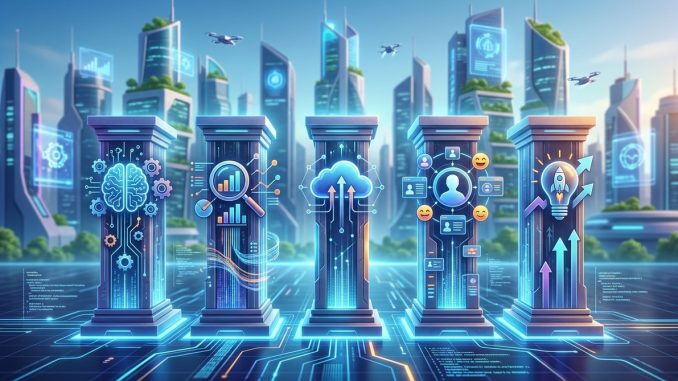
The digital playbook that worked in 2023 is already outdated. In 2026, the pace of change demands a strategy that is not just responsive but predictive. If you are leading digital initiatives, you need a framework that survives the next curveball. Here are the five pillars that will keep your business competitive.
A future-proof digital strategy in 2026 rests on five interconnected pillars: AI-powered operations, data-driven personalization, omnichannel experience, scalable tech infrastructure, and brand trust. Without any one of them, your digital initiatives risk becoming obsolete. This guide breaks down each pillar with actionable steps to build a resilient, growth-focused plan today.
Why Your Digital Strategy Needs a 2026 Overhaul
The tools and tactics that delivered results two years ago are struggling to keep up. AI has moved from experimental to essential. Customer expectations for personalization are higher than ever. Privacy regulations are tightening. And the platforms you rely on keep changing their algorithms.
A future-proof digital strategy in 2026 is not about chasing every trend. It is about building a foundation that adapts. This means focusing on five core pillars that work together. Let us walk through each one.
Pillar 1: AI-Powered Operations and Intelligent Automation
Artificial intelligence is no longer a differentiator. It is the baseline. In 2026, businesses that do not embed AI into their core operations will fall behind as their competitors gain speed and efficiency.
AI helps you automate repetitive tasks, predict customer behavior, and optimize campaigns in real time. But the key is to use it thoughtfully. Do not just slap a chatbot on your website. Instead, integrate AI into your workflows.
How to Implement AI the Right Way
Follow these three steps:
- Audit your current processes. Identify which tasks eat up the most time. Common candidates are data entry, email sorting, content scheduling, and customer support triage.
- Choose AI tools that fit your stack. Look for platforms that integrate with your existing CRM, analytics, and content management system. Avoid adding standalone tools that create data silos.
- Start small and iterate. Pick one high-impact area, like automating lead scoring or personalizing email subject lines. Measure the results before expanding.
A good example is using AI to analyze website visitor behavior and serve personalized product recommendations. That is already standard. The next step is using AI to predict churn and trigger retention campaigns automatically.
Expert advice: "Automation should free up your team for strategic thinking, not replace it. The best AI strategies augment human creativity and judgment." — Sarah Kim, VP of Digital Innovation at NexGen
Pillar 2: Data-Driven Personalization and Insights
Data is the fuel for every other pillar. Without reliable data, your AI models will be inaccurate, your customer experience will feel generic, and your technology investments will miss the mark.
In 2026, the challenge is not collecting data. It is making sense of it. Customers are wary of how their information is used. Privacy laws like state-level regulations in the US require transparency. A future-proof digital strategy must balance personalization with trust.
Building a Data Foundation
You need three things:
- A unified customer data platform (CDP) that pulls information from all touchpoints.
- Clear governance policies for consent and data retention.
- A measurement framework that ties data insights to business outcomes.
For more on how to turn data into growth, check out our guide on maximize business growth with data-driven digital strategies.
Pillar 3: Seamless Omnichannel Experience
Customers today interact with brands across email, social media, search, in-app messaging, and physical stores. They expect each interaction to feel connected. If a customer adds an item to their cart on mobile, they want to see that cart on desktop without re-entering details.
Omnichannel is not about being on every platform. It is about consistency and context. A future-proof digital strategy in 2026 designs journeys that flow smoothly between channels.
Common Pitfalls to Avoid
| Mistake | Best Practice |
|---|---|
| Treating channels in silos | Use a shared customer view across teams |
| Overloading every channel | Prioritize channels where your audience spends time |
| Ignoring mobile-first design | Optimize for mobile, then scale to other devices |
| Forgetting offline touchpoints | Connect in-store or phone interactions to digital profiles |
A practical way to start is by mapping a single customer journey. Identify where the handoffs are clunky and fix them one by one.
Pillar 4: Scalable and Secure Technology Foundation
Your technology stack must grow with you. Too many businesses build on fragile, custom systems that break under pressure. In 2026, the focus is on modular, cloud-based infrastructure that can scale up or down based on demand.
Security is equally critical. Data breaches erode customer trust and can cost millions. A future-proof strategy includes regular security audits, encryption, and a clear incident response plan.
Key Components of a Solid Tech Stack
- Headless CMS for flexible content delivery across devices.
- Cloud hosting with auto-scaling capabilities.
- API-first architecture to easily integrate new tools.
- Zero-trust security model to verify every access request.
If you are rebuilding your website or digital platform, read our ultimate guide to building high-impact websites for digital transformation. It covers choosing the right tech foundation for long-term growth.
Pillar 5: Purpose-Driven Brand and Community Trust
The final pillar is the one many overlook. In a world of AI-generated content and automated interactions, human connection matters more than ever. Customers want to buy from brands they trust and that stand for something.
A future-proof digital strategy in 2026 includes building a brand that is authentic, transparent, and engaged with its community. This goes beyond posting on social media. It means listening to feedback, acting on it, and communicating openly.
How to Build Brand Trust Digitally
- Share behind-the-scenes stories about your team and process.
- Respond to comments and messages personally, not with generic replies.
- Publish thought leadership that adds real value, not just promotional content.
- Support causes that align with your company values.
Trust is earned slowly but lost fast. A single misstep can undo years of work. That is why this pillar must be woven into every other aspect of your strategy.
For more on creating content that builds authority and trust, see our mastering content strategy for digital business success.
Putting the Five Pillars into Action
Knowing the pillars is only half the battle. You need a plan to implement them. Here is a simple process to get started.
- Assess your current state. Rate your organization on each pillar from 1 to 5. Be honest about weaknesses.
- Identify quick wins. Which pillar can you improve with minimal resources? Often, fixing data quality or adding a single AI tool yields fast results.
- Create a roadmap. For each pillar, list initiatives, owners, and deadlines. Start with the highest-impact items.
- Measure and adapt. Set metrics for each pillar and review them monthly. Adjust your plan as the market changes.
Remember that the pillars support each other. Improving your data foundation will make your AI efforts smarter. Building trust will make your omnichannel campaigns more effective.
A Forward-Looking Digital Strategy Starts Today
The businesses that thrive in 2026 will not be the ones with the biggest budgets. They will be the ones that build a resilient, adaptable digital strategy rooted in these five pillars. Start where you are, pick one pillar to strengthen, and keep moving forward. If you need deeper guidance, our team at Adelphi Digital specializes in harnessing digital strategy to accelerate business transformation. We are here to help you future-proof your growth.
Leave a Reply