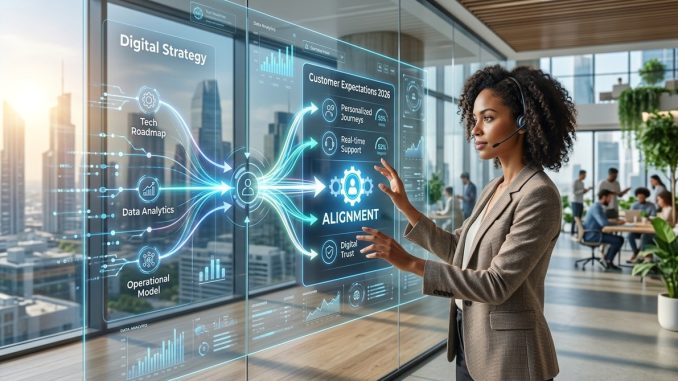
The gap between what customers expect and what your digital strategy delivers is widening every month. In 2026, that gap can cost you revenue, reputation, and relevance. Consumers have grown accustomed to personalized, frictionless experiences across every touchpoint. They expect brands to know them without being creepy, to solve problems before they arise, and to respect their privacy while still being helpful. Meeting those expectations is no longer a nice-to-have. It is the core of any successful digital strategy.
Aligning your digital strategy with customer expectations in 2026 requires a shift from campaign thinking to continuous experience design. Marketers must use real-time data, embrace hyper-personalization, build trust through privacy, and unify channels. This article outlines a five-step process, common mistakes to avoid, and KPIs that matter most. By 2026, the brands that win will be the ones that listen better and adapt faster.
Why Customer Expectations Are Changing in 2026
In 2026, two powerful forces are reshaping what people want from digital experiences. First, artificial intelligence has become invisible and everywhere. Your customers interact with AI daily through smart assistants, predictive text, and curated content feeds. They expect the same level of anticipation from your website, app, or email. If you ask a chatbot a question, they expect an answer that feels human. If they browse a product category, they expect personalized recommendations that actually fit their taste.
Second, privacy regulations have matured. California’s CPRA, Europe’s ePrivacy, and similar laws in other states have made consumers more aware of their data rights. But oddly enough, that awareness has not reduced their desire for personalization. In fact, a 2025 Adobe study found that 73% of US consumers expect personalized experiences, even as 68% worry about how their data is used. The challenge is to deliver tailored interactions while respecting boundaries and being transparent.
A third factor is the rise of the “connected customer.” Your audience moves between Instagram, your website, email, SMS, and in-store without pause. They expect the conversation to continue seamlessly. If someone adds a product to their cart on mobile, they want that cart waiting when they open your site on desktop. If they return an item in store, they want the refund reflected in their account immediately. Any break in continuity feels like a failure.
For marketing managers and digital strategists, this means your 2026 plan must center on trust, speed, and unification. That is the foundation for everything that follows.
Five Steps to Align Your Digital Strategy With Customer Expectations in 2026
Aligning your strategy is not a one-time project. It is an ongoing process of listening, adjusting, and testing. Here is a practical five-step process you can start using today.
-
Audit your current experience with a customer journey map. Walk through every touchpoint from discovery to post purchase. Use actual customer data, not assumptions. Identify where expectations are not met. For example, if your checkout process requires too many clicks or asks for data you don’t need, that is a gap. Map out the ideal experience that a customer would want in 2026. Then compare.
-
Collect real-time signals, not just historical data. Relying on last year’s purchase data is not enough. Use tools that capture behavioral data in the moment. What page did a visitor land on? How long did they stay? Did they watch the video? Did they start a form and abandon it? These signals let you adapt the experience on the fly. For instance, if someone reads three blog posts about email marketing, serve them a relevant lead magnet immediately.
-
Personalize with permission and transparency. Weave personalization into every interaction, but always let the user control their preferences. Use first-party data that customers willingly share. Show a clear privacy notice and a simple way to opt out. Brands that earn trust see higher engagement. A 2026 customer will forgive a less personalized experience if they feel respected. They will punish a brand that feels intrusive.
-
Unify your channels into one continuous conversation. Your CRM, email platform, website analytics, and customer support tools must talk to each other. If your support team cannot see what the customer searched for on your site, you are working blind. Use an integration layer or a customer data platform (CDP) to keep everything connected. This is not about technology for its own sake. It is about making the customer feel known.
-
Test, measure, and iterate weekly. Customer expectations in 2026 will shift faster than your annual plan can handle. Adopt a test-and-learn mindset. Run A/B tests on landing pages, email subject lines, and personalization algorithms. Track metrics like customer effort score (CES) and net promoter score (NPS) in real time. Use a dashboard to spot trends and act. For more on building a data-driven approach, check out implementing data-driven digital strategies to fuel business growth in 2026.
Common Mistakes That Break Alignment
Even with the best intentions, many teams trip over the same pitfalls. The table below shows the most frequent mistakes and how to fix them.
| Mistake | Why It Fails | Fix for 2026 |
|---|---|---|
| Treating personalization as product recommendations only | Customers expect personalization across content, messaging, and timing. | Personalize the entire journey: emails, site banners, chatbot responses, and post-service follow ups. |
| Ignoring mobile behavior | Over 60% of web traffic in 2026 is mobile. Desktop only designs cause friction. | Design mobile first, then scale up. Test all experiences on real devices, not just emulators. |
| Using too many tools that don’t share data | Data silos prevent a unified view of the customer. | Invest in a CDP or strong API integrations. Map data flows between systems. |
| Focusing on acquisition over retention | Customer expectations are shaped by every interaction, not just the first one. | Prioritize post purchase experience: onboarding, support, loyalty programs. |
| Over promising and under delivering | AI promises can set unrealistic expectations. | Be honest about what your system can do. Set clear timelines and fallback options. |
What the Experts Are Saying
“In 2026, the most successful digital strategies will be those that treat every customer interaction as a signal. Not as a transaction. Alignment comes from listening to those signals continuously, not from a quarterly planning document.” — Dr. Karen Liu, Professor of Digital Marketing, NYU Stern School of Business
Key Performance Indicators to Watch
To know if your alignment efforts are working, focus on these KPIs:
- Customer Effort Score (CES): How easy is it for customers to get what they need? Lower effort correlates with higher loyalty.
- First Contact Resolution Rate: Are issues resolved in a single interaction? If not, your digital experience is fragmented.
- Personalization Impact Rate: Measure the lift in conversion when personalization is active versus a control group.
- Channel Continuity Score: Track how many users move between channels without restarting their journey.
- Privacy Trust Index: Use a short post-interaction survey asking, “Did you feel your data was used respectfully?”
Building a system to track these metrics is covered in why your digital strategy needs a performance dashboard in 2026.
Making Customer Alignment Your Competitive Edge
Aligning your digital strategy with customer expectations in 2026 is not a one time project. It is a discipline. It requires you to listen constantly, adapt without ego, and put the customer’s real needs ahead of internal convenience. The brands that master this will not just survive the next year. They will own the market.
Start with the five steps above. Run a journey audit. Fix one channel at a time. Measure what happens. Then repeat. The customers of 2026 will reward you with their loyalty, their referrals, and their trust. And that is the only growth strategy that truly lasts.
For a deeper look at building a flexible approach, read how to build an agile digital strategy that adapts to market changes in 2026. And if you want to stay ahead of emerging trends, follow our key digital trends shaping the future of business growth guide.
Leave a Reply