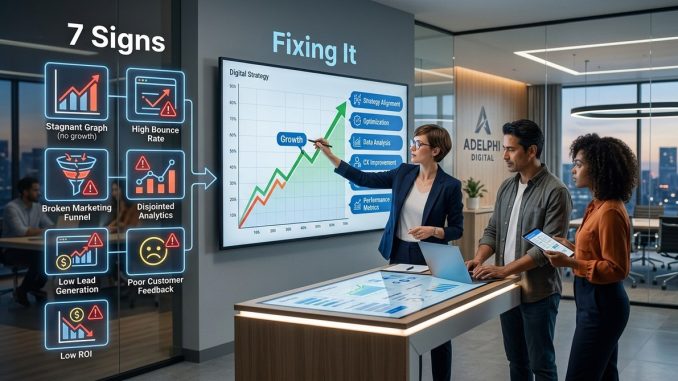
You pour time, budget, and energy into your digital strategy. But the needle is not moving. Maybe traffic feels stuck. Maybe leads dried up. Maybe you are doing more work for less return. These are not just bad days. They are signals. Your strategy is sending you a message, and ignoring it will cost you. The truth is, most teams recognize something feels off but cannot name the problem. That is where this guide comes in. We are going to name 7 specific signs your digital strategy isn’t working. For each one, you get a clear fix. No corporate fog. Just honest talk about what is broken and how to fix it.
Your digital strategy should drive growth, not drain resources. If traffic is flat, conversions are low, or you’re chasing vanity metrics without real results, something is off. This guide walks through 7 clear signs your digital strategy isn’t working for your business in 2026. Each sign comes with a practical fix so you can get back on track. No fluff. Just the honest signals that tell you where to focus next for sustainable business growth.
Sign 1: Your Website Traffic Is Flat or Dropping
You used to see steady month-over-month growth. Now the line on your analytics chart looks like a flat tire. Or worse, it is sloping down. This is often the first visible sign that something in your digital approach has stalled.
Traffic stagnation usually points to one of three problems. Your SEO strategy is outdated. Your content is not matching search intent. Or your competitors have outmaneuvered you on keywords that used to be easy wins.
The fix: Start with a content audit. Pull your top 20 pages from last year and check where rankings have slipped. Then look at what your competitors are ranking for that you are not. Update old posts with fresh data, new examples, and current year references. Google rewards recency, especially in 2026.
If you want to build a more resilient approach, look at how to build an agile digital strategy that adapts to market changes in 2026. The goal is to stop reacting and start planning.
Sign 2: You Are Getting Traffic but No Conversions
Traffic without conversions is a ghost town with a welcome mat. Visitors come, look around, and leave. No email signups. No demo requests. No sales.
This is one of the most frustrating signs your digital strategy isn’t working. It means your marketing is doing its job on the top end, but the rest of the funnel is broken.
Common culprits include confusing calls to action, slow page load times, mismatched messaging between ads and landing pages, or a checkout process that feels like a maze.
The fix: Map your user journey from first click to conversion. Then identify the drop-off points. Use this numbered process to diagnose the issue:
- Open your analytics and find the page with the highest traffic but lowest conversion rate.
- Review the page copy. Does it match the promise from the ad or search result?
- Test your load speed on mobile. If it takes more than 3 seconds, you are losing people.
- Simplify your form. Fewer fields almost always mean more submissions.
- Add a clear, single action button above the fold.
A strong conversion path is a core part of a high-performance digital strategy in 2026. If your funnel is leaking, fix the leak before you add more traffic.
Sign 3: Vanity Metrics Are Running the Show
You celebrate 10,000 page views. You tweet about your email list size. But when someone asks how many deals those numbers produced, you change the subject.
Vanity metrics feel good. They do not pay the bills. If your reporting dashboard is full of likes, shares, and impressions without any connection to revenue, you are looking at a decorated scoreboard that has nothing to do with the actual game.
| Vanity Metric | Meaningful Metric |
|---|---|
| Page views | Pages per session and time on page |
| Social media likes | Click-through rate and referral traffic |
| Email list size | Open rate and conversion rate |
| Impressions | Cost per lead and return on ad spend |
| Downloads | Activation rate and qualified leads |
The fix: Switch your reporting to metrics that tie directly to business outcomes. Cost per acquisition, customer lifetime value, and lead-to-close ratio tell you what is actually working. If your agency or team resists this shift, that is a red flag.
A data-driven approach to your strategy can help you focus on what matters. For a deeper look, check out implementing data-driven digital strategies to fuel business growth in 2026.
Sign 4: Your Content Is Not Getting Any Engagement
You publish blog posts, videos, and social updates. Crickets. No comments, no shares, no replies. Your content exists in a vacuum.
This is a clear sign your digital strategy is not connecting with your audience. You may be writing about topics your team finds interesting instead of topics your customers are searching for. Or your content may be too generic. In 2026, generic content gets ignored.
Here are the telltale signs of weak content:
- High bounce rate (above 70 percent) on blog posts
- Low average time on page (under 30 seconds)
- Zero comments or social shares on recent posts
- No one clicks your internal links
- Your email open rates are dropping
The fix: Stop guessing what your audience wants. Use search data, customer interviews, and forum research to find real questions people are asking. Then create content that answers those questions directly. Short, useful, and specific beats long and fluffy every time.
Mastering content strategy for digital business success is about matching your content to the user’s intent. Give people what they came for, and engagement will follow.
Sign 5: Your Team Is Spinning Wheels Without a Clear Plan
You have a team full of talented people. They are busy. They are producing. But when you ask what the strategy is, everyone gives a different answer. That is a problem.
Activity is not progress. If your team is running campaigns in silos, chasing random ideas, or changing direction every week, you do not have a strategy. You have a to-do list.
The fix: Create a single source of truth for your digital strategy. It should include your target audience, your core message, your primary channels, and your key performance indicators. Every campaign should tie back to this document. If it does not, do not do it.
A well defined plan is part of what separates a real strategy from busy work. To see what a solid foundation looks like, read about the 5 pillars of a future-proof digital strategy in 2026.
Sign 6: You Cannot Measure What Is Working
You log into your analytics platform and feel lost. Too many reports. Too many numbers. Nothing clearly says “this is working” or “this is broken.”
If you cannot measure your performance, you cannot improve it. This is one of the most overlooked signs your digital strategy isn’t working. You may have data overload without insight.
The fix: Simplify. Pick three to five metrics that matter most to your business right now. Put them on a single dashboard. Review them weekly. If a metric is green, keep doing what you are doing. If it is red, investigate and adjust.
A performance-driven approach to digital strategy makes measurement a priority, not an afterthought. You need to know what is working so you can double down on it.
Sign 7: You Are Still Using the Same Playbook from 2024
The digital landscape moves fast. What worked two years ago may be dead today. In 2026, search algorithms, social platforms, and user behavior have all shifted. If your strategy has not evolved, you are falling behind.
Think about it. AI-generated summaries now appear in search results. Video content dominates social feeds. Privacy changes have reshaped how tracking works. If your playbook has not been updated to reflect any of these changes, you are playing an old game on a new field.
The fix: Schedule a quarterly strategy review. Look at your channel performance, your competitive landscape, and your customer behavior. Ask yourself what is changing in your industry and whether your strategy reflects that.
For a broader view of where things are headed, explore key digital trends shaping the future of business growth. Staying informed is the best defense against irrelevance.
“The biggest mistake most companies make is treating their digital strategy as a one time project. It needs to be a living system that evolves with the market.” This advice from a senior strategist we work with sums it up well. A static strategy is a dying strategy.
Your Next Move Starts With Honest Diagnosis
You have seven signs to watch for. If three or more of these feel familiar, it is time for a change. The good news is that every sign comes with a fix. You do not need a complete overhaul. You need targeted improvements that address the real problem.
Start with the sign that hurts the most. Pick one fix and apply it this week. Then measure the result. Small, focused changes compound over time. Your digital strategy can work again. You just have to be honest about what is broken and willing to try something different.
If you want to go deeper on building a strategy that actually drives growth, take a look at innovative digital strategies to drive business excellence in 2026. The right approach can turn things around faster than you think.
Leave a Reply