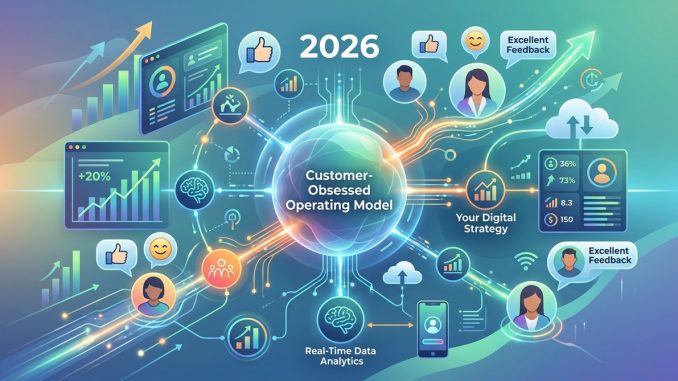
The old playbook is failing. You can feel it in every quarterly review where conversion rates flatline and customer acquisition costs spike. For the past few years, most digital strategies have been built around channels, campaigns, and quarterly goals. But in 2026, that approach is leaving money on the table. The companies that are winning right now have made a fundamental shift. They have stopped treating customer experience as a department and started treating it as the operating system for the entire business. That shift is what we call a customer-obsessed operating model. And if your digital strategy does not center on it, you are already falling behind.
A customer-obsessed operating model in 2026 means redesigning your company’s structure, metrics, and culture around what customers actually value. It goes beyond better service. It changes how you allocate budget, how you measure success, and how your teams collaborate. This article gives you the framework to make that transition without losing momentum.
What a Customer-Obsessed Operating Model Actually Looks Like
Let us get specific. A customer-obsessed operating model is not a new mission statement or a rebranded customer service initiative. It is a structural change to how your business runs.
Think of it this way. In a traditional model, the marketing team owns the top of the funnel. Sales owns the middle. Customer success owns the back end. Each team has its own budget, its own goals, and its own data. The customer feels the seams. They get a great ad, a confusing website, and then a support agent who has no idea what they were promised.
In a customer-obsessed model, the seams disappear. Budgets are pooled around customer journeys, not channels. Teams share KPIs. Data flows freely between departments. The goal is not to optimize a single touchpoint. It is to optimize the entire relationship.
This is not theory. Companies like Amazon and USAA have operated this way for years. But in 2026, the tools and the market pressure have made this model accessible to mid-sized B2B and B2C companies. The question is whether you will build it before your competitors do.
The Four Pillars of a Customer-Obsessed Operating Model
Building this model requires focus on four interconnected areas. Miss one, and the whole system wobbles.
1. Unified Customer Data
You cannot be obsessed with a customer you do not understand. Most companies have data scattered across a CRM, a marketing automation platform, a support ticketing system, and a product analytics tool. A customer-obsessed operating model requires a single source of truth.
This does not necessarily mean buying an expensive new platform. It means breaking down the silos between your existing tools. It means ensuring that when a customer calls support, the agent sees their browsing history, their past purchases, and their email interactions in one view. It means your marketing team can see when a customer is about to churn and can intervene before they leave.
2. Cross-Functional Incentives
This is the hardest part. As long as your marketing team is measured on leads and your support team is measured on ticket closure time, they will work against each other. A customer-obsessed operating model aligns incentives around outcomes like retention, lifetime value, and customer satisfaction.
You can start small. Pick one customer journey, like onboarding, and create a shared KPI for the teams involved. Measure it together. Celebrate it together. Once that works, expand to other journeys.
3. Continuous Listening Loops
Customer obsession is not a one-time survey. It is a system for constantly hearing what customers are saying, even when they are not filling out a form.
This means analyzing support transcripts for recurring frustration. It means tracking product usage patterns to see where users get stuck. It means running brief, regular intercept surveys at key moments in the journey. And most importantly, it means feeding those insights directly into your product roadmap and marketing strategy.
4. Empowered Frontline Teams
The people who talk to customers every day know what is broken. But in most organizations, they have no power to fix it. A customer-obsessed model gives frontline teams the authority to make small decisions without escalating.
For example, a support agent should be able to issue a refund or a discount without manager approval, up to a reasonable limit. A sales rep should be able to flag a feature request and see it logged in the product backlog. When you trust your team to act in the customer’s interest, the customer feels it.
How to Start Building Your Model in 2026
You do not need to overhaul your entire company overnight. Here is a practical process to get started.
-
Map your top three customer journeys. Pick the journeys that matter most to revenue and retention. Common ones are onboarding, renewal, and high-value purchase. Map every touchpoint across departments.
-
Identify the biggest seam. Look for a place where the handoff between teams causes friction. Maybe marketing promises something that sales cannot deliver. Maybe support has to reset a password because the product team never fixed the login flow. Pick one seam to fix first.
-
Create a shared metric for that seam. If the seam is between marketing and sales, use a metric like “time from first touch to qualified meeting” or “lead-to-close conversion rate.” Both teams own it.
-
Build a single data view for that journey. Connect the data sources that touch that journey. It might be a simple dashboard at first. The goal is visibility.
-
Give the frontline team one new power. Identify one decision your support or sales team can make without permission. Test it for a month. Measure the impact on customer satisfaction and resolution time.
-
Close the loop on feedback. Set a monthly meeting where customer insights are reviewed and assigned to a team for action. No insights without ownership.
Common Mistakes That Undermine the Model
Even well-intentioned efforts can go wrong. Here is what to watch for.
| Mistake | Why It Hurts | Better Approach |
|---|---|---|
| Building a customer data platform without changing team incentives | Data alone does not change behavior. Teams will still optimize for their own metrics. | Align incentives first, then build the data infrastructure to support them. |
| Making customer obsession a marketing initiative | It becomes a campaign, not a model. Other teams feel no ownership. | Start with a cross-functional steering group that includes product, support, and sales. |
| Over-investing in AI before fixing basic processes | AI amplifies bad processes. If your data is messy, AI will make it messier. | Fix the process first. Use AI to augment, not replace, human judgment. |
| Measuring satisfaction without measuring effort | High satisfaction scores can hide high-effort experiences. Customers will leave. | Track Customer Effort Score alongside Net Promoter Score. Low effort drives loyalty. |
“The biggest barrier to customer obsession is not technology. It is the way we organize our teams and measure their success. Until you change the incentives, you are just rearranging deck chairs.” — Jeanne Bliss, former CXO at Microsoft and author of Chief Customer Officer
The Metrics That Matter in a Customer-Obsessed Model
When you shift to this model, your dashboard changes. Here are the metrics that tell you if it is working.
- Customer Lifetime Value (CLV). Are customers staying longer and spending more? This is the ultimate measure of whether your model is working.
- Customer Effort Score (CES). How hard is it for customers to get what they need? Low effort correlates strongly with retention.
- Net Promoter Score (NPS) by journey stage. Not just overall NPS, but how likely a customer is to recommend you after onboarding, after a support interaction, and after renewal.
- Time to value. How long does it take a new customer to achieve their first meaningful outcome with your product? Shorter time to value means higher retention.
- Internal metric: cross-functional collaboration score. This is a pulse check. Survey your teams quarterly on how well they feel they are collaborating across departments. It predicts customer outcomes.
Why 2026 Is the Year to Make the Shift
Several forces are converging that make this model not just desirable, but necessary.
First, customer expectations have permanently shifted. People now expect the seamlessness they get from companies like Amazon and Spotify. They do not care if your company has separate departments. They expect you to know who they are and what they need.
Second, AI has made unified data practical. Tools that were expensive and complex five years ago are now accessible and relatively easy to implement. The barrier is no longer technology. It is organizational will.
Third, the cost of inaction is rising. As your competitors adopt customer-obsessed models, they will capture your best customers. Churn will increase. Acquisition costs will climb. The window to make this shift is narrowing.
If you want to understand how this connects to a broader performance-driven approach, read our guide on why your digital strategy must be performance-driven in 2026. It covers how to measure the financial impact of these changes.
How to Sell This Model to Your Leadership
You may be convinced. But your CFO or CEO may need more evidence. Here is how to frame it.
- Start with a single journey. Pick one that is clearly broken. Map the current cost of that brokenness in lost revenue, support hours, and churn. Then estimate the improvement from a unified approach.
- Focus on retention. It is almost always cheaper to keep a customer than to acquire a new one. A customer-obsessed model directly improves retention. Show the math on what a 5% improvement in retention would mean for revenue.
- Use a pilot. Do not ask for a full transformation. Ask for a three-month pilot on one journey with a small cross-functional team. Let the results speak for themselves.
For more on how to align your strategy with revenue growth, check out our piece on aligning digital strategy with revenue growth in 2026. It gives you the language and data points to make the business case.
Building Your Roadmap for the Rest of the Year
Here is a bulleted list of actions you can take in the next 90 days.
- Audit your top three customer journeys for friction points between teams.
- Identify one shared KPI that two departments can own together.
- Connect your CRM and support platform to create a basic unified customer view.
- Empower your support team with one new decision-making authority.
- Set up a monthly cross-functional customer insights review.
- Measure your current CLV, CES, and NPS as a baseline.
- Run a pilot on one journey and track the results for six weeks.
If you are further along in your journey, you might also look at how to use customer data to refine your digital strategy in 2026. It digs deeper into the data infrastructure piece.
Making Customer Obsession Your Competitive Advantage
The companies that win in 2026 will not be the ones with the biggest ad budgets or the flashiest websites. They will be the ones that make every interaction feel like it was designed for the person having it. That is what a customer-obsessed operating model delivers.
It is not easy. It requires changing how you budget, how you measure success, and how your teams work together. But the payoff is real. Higher retention. Lower acquisition costs. More referrals. And a team that actually enjoys coming to work because they are solving real problems for real people.
You do not have to do it all at once. Pick one journey. Fix one seam. Give one team more power. Measure the result. Then do it again. That is how you build a customer-obsessed operating model that actually works.
And if you need help getting started, we have a full library of resources on building a digital strategy that scales with your business in 2026. The tools are ready. The market is ready. The only question is whether you are ready to make the shift.
Leave a Reply