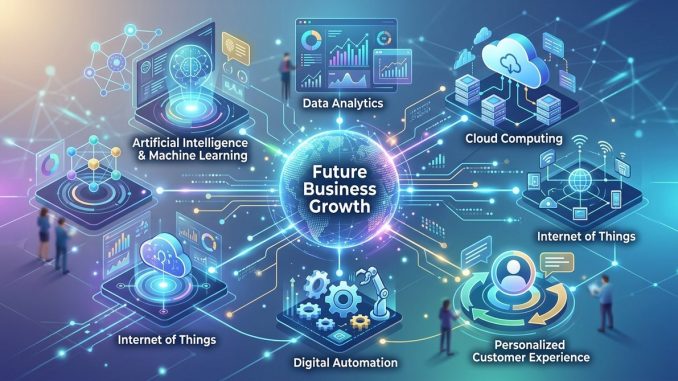
Businesses face a rapidly changing digital landscape. As 2026 approaches, staying current on emerging trends is key to driving growth and staying competitive. From advances in artificial intelligence to shifts in customer expectations, understanding these digital trends helps leaders make smarter, faster decisions. This guide uncovers the top technological shifts shaping the future of business. Whether you’re leading a startup or managing an enterprise, these insights will help you position your organization for success in the years ahead.
By 2026, digital trends such as AI integration, automation, [cybersecurity innovations](https://www.cdc.gov/cybersecurity/index.html), and data-driven personalization will redefine how businesses operate and grow. Staying adaptable and embracing these shifts will be crucial for long-term success.
Understanding the core forces shaping digital growth in 2026
Digital transformation is no longer a choice but a necessity. As technology matures, certain trends emerge as dominant forces that will influence business strategies and operational models. These trends are driven by evolving customer demands, technological breakthroughs, and a landscape that rewards agility and innovation. Let’s examine the most impactful trends to watch.
1. Artificial intelligence becomes more integrated and intelligent
AI continues to evolve from experimental technology to a core business function. By 2026, companies will use AI to personalize customer experiences, optimize supply chains, and automate complex tasks. Generative AI models will generate content, design products, and even support decision-making. AI’s role in predictive analytics will help businesses anticipate market shifts and customer needs.
Practical process:
- Invest in scalable AI infrastructure that integrates with existing systems.
- Train teams on AI capabilities and ethics to maximize responsible use.
- Develop pilot projects to test AI-driven personalization and automation.
Key techniques and common mistakes:
| Techniques | Mistakes to avoid |
|---|---|
| Using AI for customer segmentation | Relying solely on AI without human oversight |
| Implementing AI-powered chatbots | Ignoring data privacy concerns |
| Leveraging predictive analytics | Overlooking bias in data sets |
“AI is no longer just a tool; it’s a strategic partner that can unlock new growth avenues when deployed thoughtfully.” — Tech analyst Jane Doe
2. Automation transforms operational efficiency
Automation will reach new heights with advancements in robotics, process automation, and intelligent workflows. Businesses will automate routine tasks across sales, HR, finance, and customer service. This shift allows teams to focus on strategic activities that add higher value.
Steps to adopt automation effectively:
- Map out repetitive tasks that can be automated.
- Choose automation tools that integrate seamlessly with current platforms.
- Regularly review automation processes to improve and adapt.
Scanning list:
- Streamlined workflows
- Reduced manual errors
- Faster decision cycles
- Increased employee satisfaction
3. Cybersecurity innovations keep pace with threats
As digital adoption accelerates, so do cyber threats. In 2026, cybersecurity will emphasize AI-driven threat detection, zero-trust architectures, and proactive breach prevention. Protecting data assets and maintaining customer trust will require continuous innovation.
Techniques to strengthen cybersecurity:
- Implement multi-layered defenses
- Use AI to identify anomalies
- Conduct regular security audits
- Educate staff on cyber hygiene
Mistakes to avoid:
| Techniques | Mistakes to avoid |
|---|---|
| Relying on outdated security protocols | Ignoring insider threats |
| Neglecting third-party risk management | Overlooking AI-based attack vectors |
“Cybersecurity is a moving target. Staying ahead requires a mindset of continuous adaptation and investment.” — Security expert John Smith
4. Data-driven personalization becomes standard
Customer expectations for personalized experiences are growing. By 2026, businesses will harness first-party data and advanced analytics to tailor products, services, and marketing messages. Hyper-personalization will lead to higher engagement and loyalty.
Practical steps:
- Build robust data collection frameworks respecting privacy laws.
- Use AI to analyze customer behavior in real time.
- Create flexible content management systems for rapid personalization.
Bulleted list for quick reference:
- Collect consented customer data
- Leverage AI for segmentation
- Test and iterate personalization strategies
- Focus on seamless customer journeys
5. Edge computing and Internet of Things expand reach
The proliferation of IoT devices will drive edge computing, bringing data processing closer to devices. This reduces latency and enables real-time insights for industries like manufacturing, healthcare, and logistics.
Implementation tips:
- Identify high-value IoT applications
- Invest in secure edge infrastructure
- Collaborate with device and network providers
Common pitfalls:
- Overlooking security in edge deployments
- Underestimating data management complexities
6. Digital experiences go immersive
AR and VR technologies will become more mainstream, offering immersive shopping, training, and collaboration experiences. Businesses using these tools will create deeper engagement and stand out from competitors.
How to leverage immersive tech:
- Develop pilot projects in marketing or training
- Partner with AR/VR specialists
- Focus on user-friendly interfaces
Mistakes to avoid:
| Techniques | Mistakes to avoid |
|---|---|
| Creating generic AR content | Ignoring user feedback in design |
| Overinvesting without clear ROI | Neglecting accessibility features |
7. Low-code and no-code tools democratize development
The rise of low-code and no-code platforms will enable non-technical staff to build apps and automate workflows. This accelerates digital adoption and reduces reliance on IT departments.
How to succeed:
- Identify suitable processes for citizen development.
- Provide training and governance frameworks.
- Monitor and support projects for alignment with goals.
Common mistakes:
- Overextending DIY solutions
- Ignoring security and compliance
Making the trends work for your business
To capitalize on these digital shifts, organizations need a clear plan. Here are three steps to embed these trends into your growth strategy:
- Assess your current capabilities. Identify gaps in technology, skills, and processes.
- Prioritize initiatives based on impact and feasibility. Focus on areas where quick wins are possible.
- Foster a culture of continuous learning. Keep teams updated on new tools and methods.
Techniques versus pitfalls table
| Techniques | Mistakes to avoid |
|---|---|
| Regularly updating digital infrastructure | Relying on outdated systems |
| Investing in staff training on new tech | Ignoring user feedback and adoption challenges |
| Establishing cross-functional teams | Siloed decision-making |
Harnessing expert insights to navigate change
“Success in the digital era hinges on agility and a willingness to adapt. Leaders need to foster innovation while managing risks effectively.” — Digital strategist Lisa Green
Staying ahead in a shifting digital landscape
Remaining flexible and curious is vital as new trends emerge. Regularly review your tech stack and business processes. Engage with industry communities and attend relevant events. Leveraging external expertise can accelerate transformation.
Connecting digital growth to business resilience
The trends outlined here are not isolated. They combine to form a resilient, innovative foundation. Businesses that integrate AI, automation, security, and immersive experiences will be better positioned to respond to market changes and customer expectations.
Final thoughts: Embrace the future of digital growth
The landscape of digital technology in 2026 promises exciting opportunities. By understanding these key trends and applying proven strategies, your organization can turn technological advances into a competitive advantage. Keep learning, experimenting, and adapting. That’s the best way to thrive in this dynamic environment.
Remember: the future favors those willing to innovate today. Use these insights to inform your next move and lead your business confidently into 2026 and beyond.
Leave a Reply